Valuation Engines
Stock-based compensation is a real expense. Value it like one.
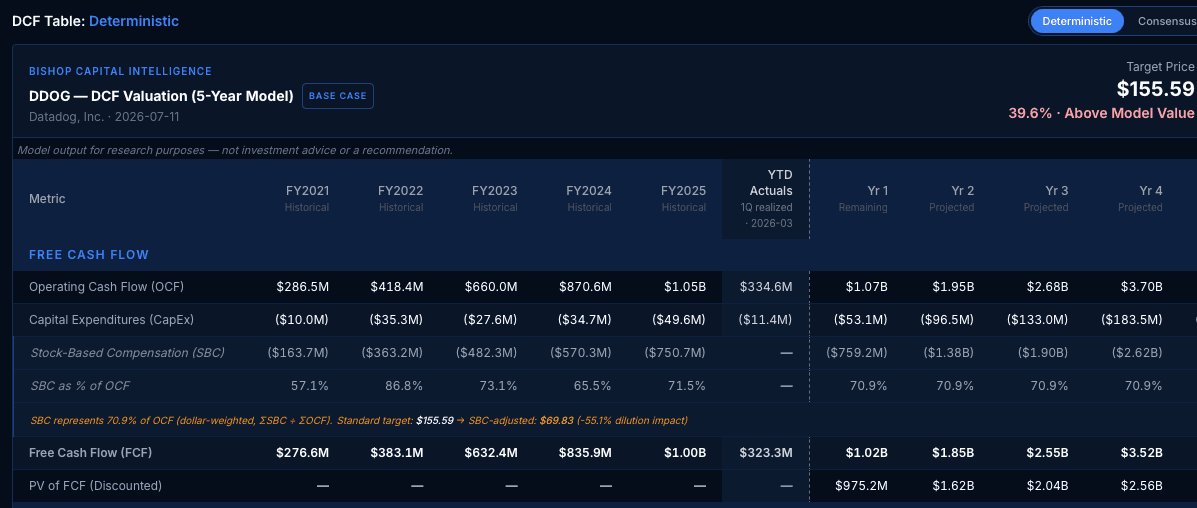
A parallel calculation recomputes free cash flow — and fair value — with stock-based compensation treated as the true cost it is.
What it tells you
Many companies, particularly in tech, report free cash flow that quietly treats stock-based compensation as free. It isn't — it's dilution, paid by you. The SBC-adjusted view recomputes FCF and the resulting valuation with compensation treated as a genuine economic expense, and shows you both numbers side by side. For some companies the difference is immaterial. For others, it is the entire investment thesis.
Who it's for
For the skeptic who reads footnotes — and knows that dilution is just an expense wearing a disguise.
How it works
- SBC dollars are extracted per fiscal year from the company's SEC EDGAR XBRL filings — not estimated.
- A second, parallel DCF runs with free cash flow reduced by SBC, reusing the primary model's WACC, growth rate, and discounting exactly — so the gap between the two targets isolates the cost of stock compensation alone.
- Both fair values appear side by side, with the dilution impact expressed as a single percentage.
- SBC intensity is dollar-weighted across the filing history (ΣSBC ÷ ΣOCF, excluding non-positive-cash-flow years), so IPO-year and downturn-year ratio spikes don't distort the adjustment — and when projected SBC exceeds modeled FCF, the tool shows "n/m" (not meaningful) instead of printing a fake number.
Included in Professional
Also in Institutional. Server-enforced twice — free-tier requests never compute or receive SBC data.
Questions
- Why do the two FCF numbers differ so much for some companies?
- Because some companies pay a large share of real compensation in equity. The adjusted view simply refuses to pretend that cost away.