Catch the turn in capital productivity.
RCPI — the Rolling Capital Productivity Index, a proprietary measure of how productively a company converts capital into results — with automatic detection of inflection points.
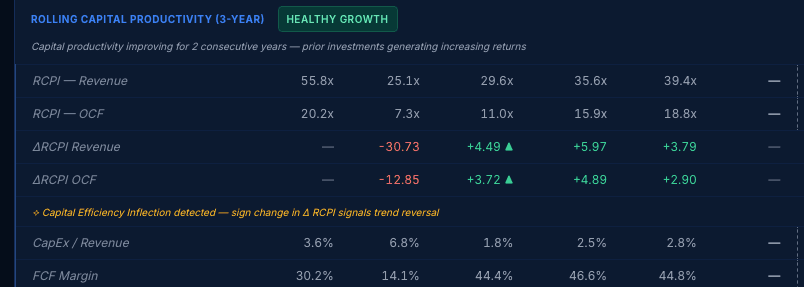
What it tells you
Great businesses are defined by what they do with capital, and the most important moments in a company's life are when that productivity inflects — when a compounding machine starts sputtering, or a turnaround quietly starts working. RCPI tracks capital productivity over time and flags those inflections automatically, surfacing turns in capital efficiency that are hard to read off the income statement alone.
Who it's for
For long-term investors who buy businesses, not tickers — and want capital-efficiency turns surfaced from the filings themselves.
How it works
- RCPI is a 3-year rolling ratio computed from SEC EDGAR filings: trailing three years of revenue — and, separately, operating cash flow — per dollar of trailing three-year capital expenditure.
- Inflection detection flags the fiscal year where the year-over-year change in RCPI switches sign — the moment capital efficiency stops deteriorating and starts improving, or vice versa.
- A four-quadrant badge classifies the latest reading — "Healthy Growth", "Growth, Compressing Margins", "Maturing, Optimizing", or "Deteriorating" — with a plain-English narrative line.
- Historical and descriptive by design: RCPI is computed from filed actuals only, and it does not feed the DCF target price.
Exclusive to Institutional. Server-enforced — RCPI data never leaves the backend for other plans.
Questions
- How is RCPI different from ROIC?
- ROIC is a snapshot ratio. RCPI is built to track the trajectory of capital productivity and detect when that trajectory changes — the inflection is the signal.